
Science
Quick, Unlabeled Optical Examination of Individual Nanovesicles


Advancements in Nanoscale Particle Analysis
In the realm of scientific research, particularly in the fields of diagnostics and nanomedicine, a groundbreaking advancement has emerged: a method for the rapid trapping and label-free optical characterization of single extracellular vesicles (EVs) and nanoparticles suspended in solution. This new technique promises to transform clinical and fundamental research by allowing scientists to study individual nanoscale entities without the cumbersome labeling processes that can introduce bias and alter the natural properties of particles.
The Challenge of Nanoscale Analysis
The study, led by Hong, I., Hong, C., Anyika, T., and their team, takes aim at a major hurdle in nanoscale particle analysis—the ability to selectively manipulate and optically examine single nanoparticles and nanoscale vesicles within their native solution environments. EVs, small lipid-bound particles secreted by cells, have gained considerable attention for their potential role as biomarkers in numerous diseases, including cancer and neurodegenerative disorders. However, the difficulty of isolating and characterizing these vesicles individually, especially in a non-invasive manner, has posed significant challenges for researchers.
Innovative Optical Trapping Strategy
At the heart of this groundbreaking work is a novel optical trapping strategy. Commonly referred to as “optical tweezers,” this technique utilizes highly focused laser beams to immobilize particles with exceptional precision. Historically, applying this technique to nanoparticles faced significant limitations due to their tiny size and low optical contrast. However, the research team successfully optimized laser parameters and implemented innovative detection schemes that take advantage of the intrinsic scattering and absorption signatures of single EVs and nanoparticles. This means that particles as small as tens of nanometers can now be efficiently trapped and analyzed, a feat that was previously unachievable at such speed and accuracy.
The Power of Label-Free Characterization
One of the most transformative aspects of this technique is its label-free nature. Traditional methods often rely on fluorescent or chemical labels to visualize and differentiate between particles, which can inadvertently alter the natural behavior of the specimens being studied. By circumventing this necessity, the new method maintains the inherent state of vesicles and nanoparticles, yielding authentic insights into their physical and optical properties. This advantage streamlines the preparation process and minimizes signal discrepancies that can arise from label inconsistencies.
Detailed Examination of Nanoscale Entities
This integrated trapping and optical analysis framework enables researchers to examine crucial parameters such as vesicle size, refractive index, shape, and even potential biochemical composition through unique light interaction profiles. Understanding these parameters is vital for deciphering the physiological roles of EVs in intercellular communication and their pathological significance in various health conditions. The method’s ability to process measurements in real-time adds an unprecedented level of throughput—a necessary feature for clinical applications that require rapid and reliable data acquisition.
Flexibility Across Particle Types and Environments
The robustness of this technology extends to its versatility in handling diverse particle types and complex biological fluids. The research team has successfully demonstrated trapping and characterization across a range of nanoparticles, accentuating the system’s adaptability. This flexibility is particularly crucial given the heterogeneous nature of EVs sourced from different tissues and physiological states.
State-of-the-Art Signal Processing
Central to this advancement is the integration of sophisticated signal processing algorithms. These algorithms analyze scattered light patterns and interference signals produced during the interaction between the trapping laser and single nanoparticles. The resulting data are then converted into high-resolution optical signatures unique to each particle, facilitating nuanced differentiation and quantification without the need for external markers. This confluence of optics and computational analysis sets a new standard for single-particle studies.
High Throughput and Rapid Results
One of the pressing demands in contemporary research is the capacity for efficient, high-throughput techniques that do not compromise measurement fidelity. Remarkably, this trapping and analysis protocol delivers results within seconds, allowing researchers to investigate numerous particles individually and monitor dynamic changes in properties over time or in response to environmental stimuli. This rapid turnaround is particularly valuable in fast-paced clinical settings.
Applications in Medical Diagnostics and Nanomedicine
The potential applications of this innovative technique are vast. In the arena of medical diagnostics, this technology could facilitate early, minimally invasive detection of disease biomarkers through liquid biopsies by directly profiling circulating EVs from blood or other bodily fluids. Furthermore, the pharmaceutical industry stands to gain from precise characterization of nanoparticle-based drug delivery mechanisms, enhancing both efficacy and safety profiles.
Enhancing Experimental Designs
Beyond its practical uses, this technique lays the groundwork for new experimental designs that allow for clearer testing of hypotheses regarding vesicle biology and nanoparticle physics. The elimination of confounding factors introduced by labeling enhances the potential to uncover subtler phenomena that previous methods may have obscured.
Future Directions
While this initial demonstration marks a significant milestone, the authors indicate a roadmap for further refinements. Future research may focus on integrating multi-modal optical measurements and expanding the range of analytical parameters that can be extracted from single particles. This development could enable scientists to discern even finer molecular details, merging the fields of nanoscale optics and molecular biology in exciting new ways.
A New Era in Nanoscale Research
The introduction of this rapid trapping and label-free characterization platform signifies a monumental leap in the field of nanoscale vesicle research. The fusion of optical physics and biomedical engineering evidenced in this work exemplifies the importance of interdisciplinary collaboration in tackling complex biological inquiries.
In summary, the research led by Hong and colleagues unfolds a promising chapter in nanotechnology and biophotonics. By demonstrating how meticulous optical manipulation paired with insightful characterization can uncover deeper truths about extracellular vesicles—central players in disease mechanisms and cellular interactions—this technique stands poised to reshape the future of diagnostics and personalized therapeutic strategies in remarkable ways.
Subject of Research:
Rapid Trapping and Label-Free Optical Characterization of Single Nanoscale Extracellular Vesicles and Nanoparticles in Solution
Article Title:
Rapid trapping and label-free optical characterization of single nanoscale extracellular vesicles and nanoparticles in solution
References:
Hong, I., Hong, C., Anyika, T. et al. Rapid trapping and label-free optical characterization of single nanoscale extracellular vesicles and nanoparticles in solution. Light Sci Appl 15, 180 (2026). https://doi.org/10.1038/s41377-026-02201-z
Keywords:
extracellular vesicles, nanoparticles, optical trapping, label-free characterization, nanomedicine, nanoscale analysis, biophotonics
Science
From ‘Psyops’ to ‘Hysterical Hysteria’: How GB News and Talk TV Lost Their Composure During Heatwaves | A Look at Climate Science Skepticism and Denial

The Heatwave Debate: A Clash of Perspectives on Climate Change
As the first heatwave of what turned out to be a record-breaking summer swept in on May 23, 2026, the discourse around climate and its impact heated up just as intensely. GB News host Cristo Foufas addressed the ongoing warnings of extreme temperatures with unmistakable frustration, stating, “I am sick to death of the naysayers saying firstly that we’re all going to die and that we have to put out heat alerts, because, you know, just drink some water and drink a bit less rosé in the sunshine.” His view resonated with an audience that appears unbothered by climate warnings, viewing them as an overreaction.
Co-host Renée Hoenderkamp, with her background as a medical doctor, provided a stark counterpoint, equating the realities of life and death in extreme conditions to “Darwinism.” This idea suggested that the natural order will prevail, a sentiment heartily echoed by fellow presenters on various platforms, including GB News contributor Will Kingston, who remarked, “People die each year from vending machines falling on them, and coconuts hitting their heads.” This cavalier attitude seemed to dismiss the very real risks associated with climate-induced heat, framing it as just another aspect of life’s unpredictability.
Over on TalkTV, the aplomb continued as another presenter, Julia Hartley-Brewer, dismissed concerns about heat-related deaths. “I’m very sorry if someone dies because of the heat, but I don’t think that’s a reason for us never to be allowed to take a flight again,” she stated while seemingly trivializing the seriousness of climate change. Hartley-Brewer’s comments highlighted a recurring theme among several hosts on these networks: a skepticism towards changes in lifestyle that might mitigate climate threats.
As temperatures soared, the direct consequences of the heatwaves became increasingly undeniable. Reports indicated that around 2,700 premature deaths occurred in England and Wales due to the heatwave in June alone. This was soon met with incredulity from some broadcasters. The TalkTV host Kevin O’Sullivan claimed that such statistics were merely “qualified” assertions and derided them as “disgraceful climate change scaremongering.” This kind of dismissal opens up a Pandora’s box regarding the handling of scientific findings in public discourse.
Then, as the data was re-evaluated on July 30, the UK Health Security Agency increased the death toll to 2,877, utilizing actual recorded deaths rather than predictive models. Yet this information was met with more skepticism. Kingston of GB News further belittled the accuracy of such data, echoing sentiments about the fallibility of modeling, a notion all too familiar to audiences conditioned by the COVID-19 pandemic.
In contrast, discussions hinting at a deeper understanding of climate issues were sorely lacking. Presenters like Ross Clark downplayed the significance of heatwave-related deaths, suggesting that many who succumbed to the heat were already at death’s door. The casual dismissal of these fatalities raises ethical concerns about whose lives are deemed valuable in the climate crisis discourse.
It’s noteworthy that while the frequency of winter-related deaths was spotlighted as a counterargument, no one seemed to inquire into the broader implications of heat-related mortality as climate change escalates. The most recent statistics from the Office of National Statistics revealed that the trend has shifted; there were more heat-related deaths in 2025 compared to cold-related deaths.
Amidst the chaotic discussions, the question of climate change denial bubbled to the surface. Presenters like Nana Akua on GB News referred to climate issues as a “scam” while others baselessly claimed that rising CO2 levels had plateaued, a viewpoint at odds with overwhelming scientific consensus. These tangential conspiracies highlight an unsettling tendency to equate mere discussion of climate change with hysteria.
Furthermore, claims regarding air conditioning—ironically necessary as British summers grow hotter—took on a life of their own. Foufas lamented about being encouraged to remove air conditioning under net-zero stipulations, merging personal inconvenience with a broader narrative against climate policy. On TalkTV, Hartley-Brewer lethargically stated that air conditioning is illegal in new builds, a claim definitively proven incorrect.
The narrative surrounding net-zero policies carries a particularly charged weight in these discussions. Contributors labeled such initiatives as “deranged” or an ideology “that doesn’t exist,” often aligning climate action with extreme political ideologies. This often leads to the reduction of complex climate science into simplistic, polarized debates—far removed from the grounded understanding that such global issues require a collective responsibility.
TalkTV hosts often drill down on economic critiques of these policies, invoking concerns about financial consequences while blissfully ignoring the long-term costs associated with inaction. Jacob Rees-Mogg was quoted suggesting that adapting to climate change’s effects would be cheaper than preventing them altogether, an argument directly contradicted by years of economic studies.
The warped logic manifested by some commentators reflects a broader resistance to both change and accountability. Claims that increased fossil fuel extraction could alleviate current economic pressures repeatedly ignore the overarching consequences on climate stability and future energy costs.
In summary, as the summer intensified temperatures, so too did the conversations surrounding climate, often veering into apathy, scapegoating, and disinformation. The ongoing discussion across platforms like GB News and TalkTV showcases a significant schism in understanding climate change’s reality, often opting for sensationalism over scientific consensus while trivializing the very real impacts of severe weather events. The dialogue surrounding these critical issues underscores a pressing need for climate education that can bridge the gap between individual perception and scientific truth.
Science
UK-Led Study Sheds Light on Fascinating Dark Matter Findings | Science and Technology Facilities Council

A Single Particle Interaction: A Glimpse into Dark Matter Using LZ Experiment
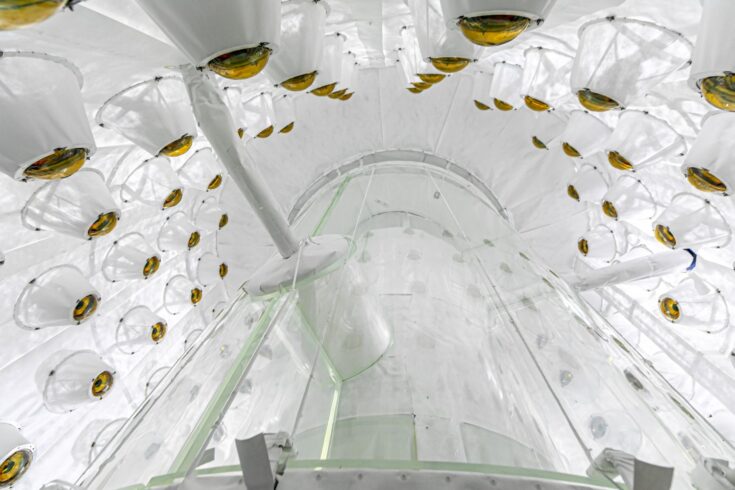
Looking up into the LZ outer detector, used to veto radioactivity that can mimic a dark matter signal. Credit: Matthew Kapust and Sanford Underground Research Laboratory
Dark matter, a mysterious component believed to constitute about 85% of the matter in the universe, has thus far eluded direct observation. However, the LUX-ZEPLIN (LZ) dark matter experiment has made headlines with a noteworthy analysis revealing a single particle interaction that has puzzled researchers. This event, spearheaded by the University of Bristol, could offer the best indication of dark matter yet, despite lacking the robust statistical backing needed to claim a definitive discovery.
The LZ experiment is a collaborative effort involving approximately 250 scientists and engineers worldwide. Situated nearly a mile underground at the Sanford Underground Research Facility (SURF) in South Dakota, it utilizes 10 tonnes of ultrapure liquid xenon to search for weakly interacting massive particles (WIMPs)—one of the leading theoretical candidates for dark matter.
Researchers from Bristol announced this single particle interaction during the 2026 TeV Particle Astrophysics conference in Japan. Their study, which will soon be available in a paper on arXiv and submitted to the journal Physical Review Letters, has ignited excitement and curiosity among physicists around the globe.
Sam Eriksen, a senior research associate at the University of Bristol and the lead author of the analysis, emphasized the importance of this finding. “We spent months investigating all possible causes of background events. Understanding our detector and the backgrounds so thoroughly allows us to consider even a single extraordinary event meaningful,” he said. “Dark matter events should be incredibly rare, after all, so identifying a handful could mark the first definitive detection of WIMP dark matter.”
If the particle interaction is indeed indicative of dark matter, it suggests that the WIMP in question has a mass surpassing 200 GeV/c², a figure more than 200 times that of a proton. This potential interaction does not neatly align with any basic theoretical models currently available, amplifying its intrigue.
The significance level of this finding sits at 2.6 sigma, implying a roughly 0.5% chance that it could stem solely from known backgrounds. While this is remarkable, it remains well short of the 5-sigma threshold recognized as a discovery in the realm of physics.
Data collection at SURF will continue, thereby providing an opportunity for researchers to monitor whether the indication of dark matter strengthens, weakens, or fades away with more data accumulation. “We’re very intrigued by this event appearing in the anticipated dark matter region, where competing backgrounds remain fairly low,” remarked Rick Gaitskell, a professor at Brown University and spokesperson for LZ. “However, we’re cautious; with just one event, we’re not claiming to have observed dark matter, but rather something noteworthy that merits sharing with the scientific community for further analysis.”
A Robust UK Involvement
The UK has played a pivotal role in the LZ experiment, with funding from the Science and Technology Facilities Council (STFC) bolstering both its construction and operations. A total of 10 UK teams contribute significantly, including prestigious institutions such as the University of Bristol, Imperial College London, and University of Edinburgh, among others.
Combining the expertise and efforts of around 250 researchers from 39 institutions, the collaboration features about 50 UK scientists who are engaged in operations, data analysis, and leadership roles since the project’s inception in 2021. The STFC’s national laboratories, specifically the Particle Physics and Technology Departments, along with the Boulby Underground Laboratory, have been integral in developing and delivering crucial components of the experiment.
Professor Henrique Araújo from Imperial College London and STFC’s Particle Physics Department leads the UK segment of the LZ project. He expressed pride in the Bristol group’s thorough scrutiny of this analysis, stating, “After a couple of years of hard work, they emerged with their findings. I eagerly anticipate examining more data. Our position today stems from the instrumental role we played in designing and constructing this fantastic apparatus.”
Professor Pawel Majewski, who heads the Dark Matter group at STFC’s Particle Physics Department and acts as an LZ co-investigator, highlighted the significance of the findings. “The achievements and advancements of LZ underscore the viability of liquid xenon technology and the necessity for ongoing explorations with larger experiments. With the results released today, transformative discoveries may be just around the corner.”
Looking Ahead: The Next Generation of Dark Matter Detection
LZ’s findings encompass notable observations, including the most significant identification of solar boron-8 neutrinos and the recent elusive signal, which could potentially hint at dark matter detection. Collectively, these results represent years of collaborative research and insist on the value of further endeavors through a larger next-generation experiment.
The UK team is actively collaborating with international partners on the XENON-LUX-ZEPLIN-DARWIN initiative, aimed at establishing a cutting-edge rare-event observatory for dark matter detection and neutrino physics. This promising project is currently backed by a preliminary activity from the UKRI Infrastructure Fund, with aspirations of setting it up at the Boulby Underground Laboratory in the near future.
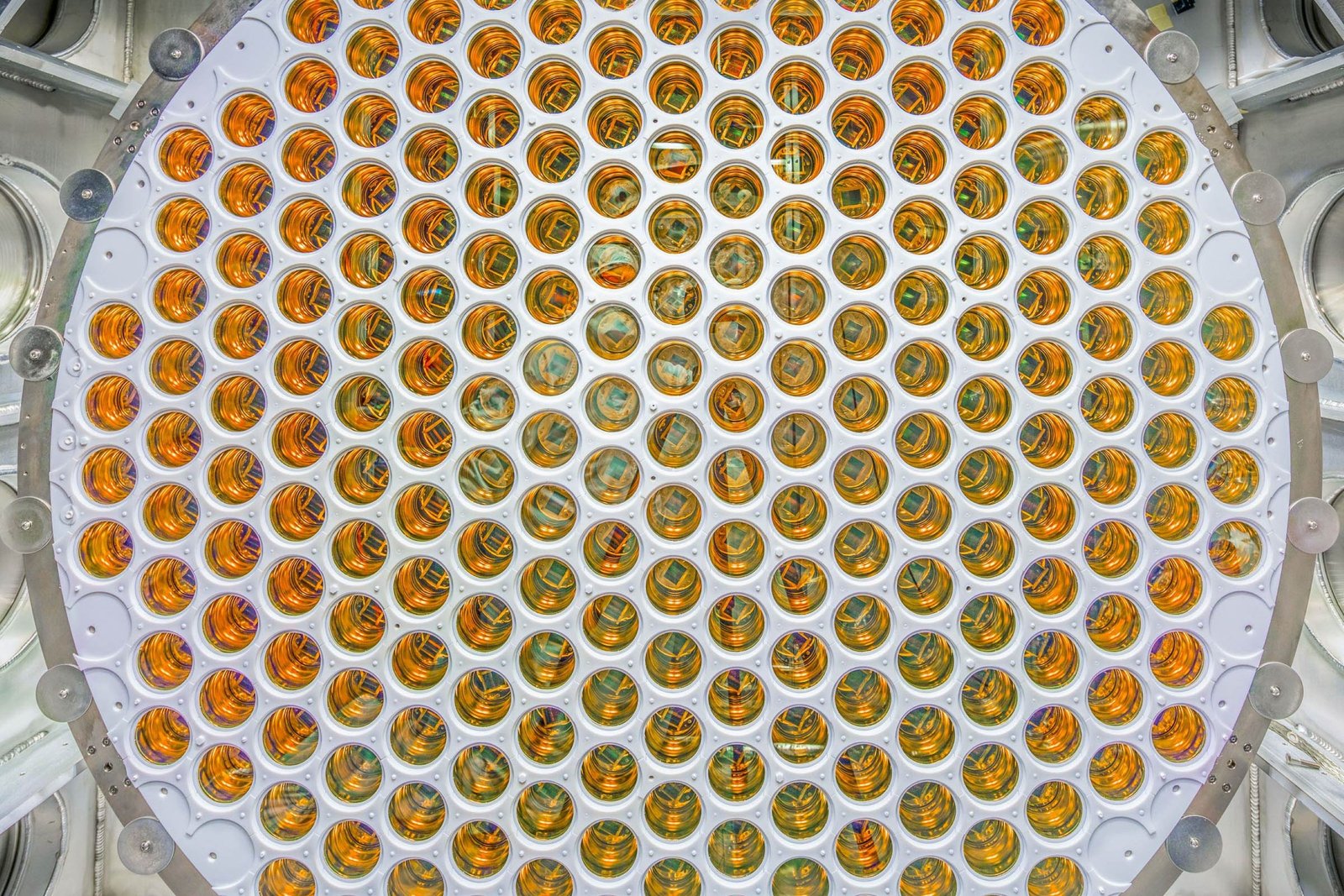
Imperial researchers help analyze a mysterious particle interaction, the most intriguing seen to date in the search for dark matter by the LUX-ZEPLIN experiment.
Dark matter remains one of the universe’s great mysteries. Despite being thought to comprise most of the matter in existence, scientists have not yet been able to conclusively identify what it is. Recent findings from the LUX-ZEPLIN (LZ) experiment have shifted the focus back onto this enigmatic topic, reporting an unusual particle interaction that has captured the attention of the scientific community.
In a groundbreaking study, the LZ collaboration reported detecting a single particle interaction that defies explanation through known signals from ordinary particles. While this anomaly does not meet the criteria for a discovery, it marks the most compelling potential signal connected to dark matter identified by the experiment so far. This finding was officially presented at the 2026 TeV Particle Astrophysics conference in Japan, with plans for the paper to be published on arXiv and submitted to Physical Review Letters.
The LZ experiment stands as the world’s most sensitive dark matter detector, expertly designed to search for weakly interacting massive particles (WIMPs), considered as strong candidates for dark matter. Located nearly a mile underground at the Sanford Underground Research Facility (SURF) in South Dakota, the experiment utilizes liquid xenon to hunt for the rare collisions that might provide evidence of dark matter’s existence.
The intriguing event was identified in data collected over 220 live days from March 2023 to April 2024. Unlike earlier searches focusing on lower-energy interactions, this recent study examined higher-energy signals where they anticipated encountering episodes with minimal background interference. The discovery is particularly surprising, as early predictions indicated that any signal from WIMPs would present itself initially at lower energy levels.
If indeed this particle interaction is linked to dark matter, it could imply a heavier variant of WIMPs than previously anticipated. Rick Gaitskell, a professor at Brown University and the spokesperson for the LZ collaboration, expressed excitement, stating, “We’re intrigued to see this event in the data, in the region where we expect dark matter to show up and the competing backgrounds are very low.” However, Gaitskell emphasized caution, noting that with only one event observed, they are not making claims about discovering dark matter but rather sharing something noteworthy that warrants further investigation.
A Mystery Signal Scientists Can’t Yet Explain
The statistical significance of this surprising result is currently measured at 2.6 sigma. This indicates that the collaboration is proceeding with caution regarding its interpretation. The LZ team employs advanced methodologies, including multiple layers of active shielding, to filter out signals generated by cosmic rays, neutrons, and other background particles—essentially noise that could mask genuine signals from dark matter.
Professor Henrique Araújo from Imperial College and the STFC remarked, “We shouldn’t be too surprised that rare event searches are also sensitive to rare backgrounds, so we need to analyze more data to be sure. But these are certainly interesting times!” This highlights the complexity of distinguishing between potential signals of dark matter and various background processes.
The collaboration comprises an international team of 250 scientists and engineers from 39 institutions and is managed by the US Department of Energy’s Lawrence Berkeley National Laboratory. The UK contingent gathers researchers from ten institutions, all pulling together efforts led by Professor Araújo.
Sam Eriksen, a senior research associate at the University of Bristol and the lead author on the upcoming paper, emphasized the importance of their findings. He stated, “This was a detailed study in a region we hadn’t explored within this dataset. We understand our detector and the backgrounds so well that even a single outstanding event, like the one we found, is important. We expect dark matter events to be extremely rare, so only a handful could mark the first detection of WIMP dark matter.”
Researchers at Imperial have contributed significantly across all aspects of the LZ experiment—from development to analysis—and have assisted in scrutinizing this unusual particle interaction. Imperial President’s Scholar Elisa Jacquet expressed her excitement, having developed a new framework for analyzing LZ waveforms that contributed to confirming aspects of the event itself, all while on-site in South Dakota during its recording.
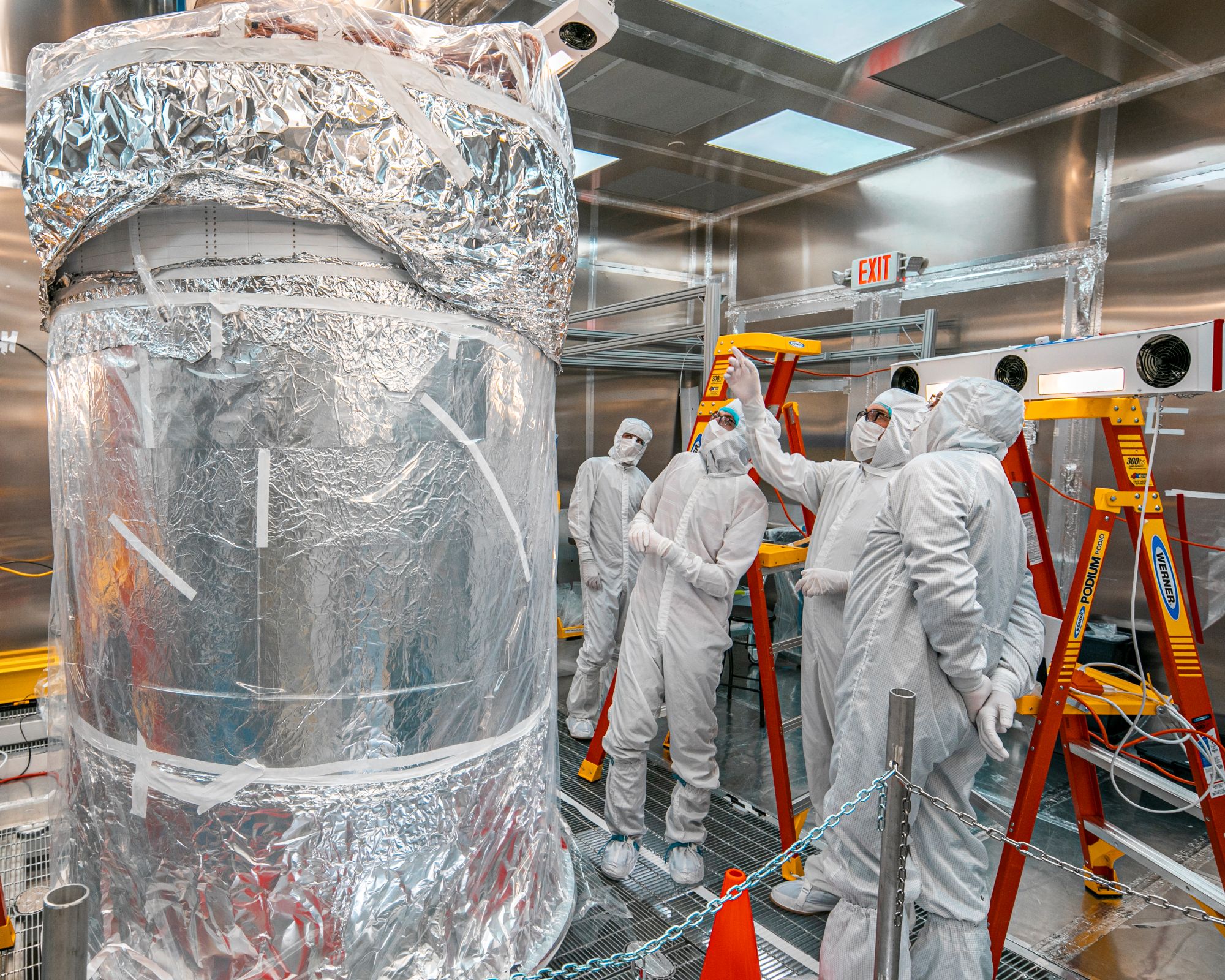
Researchers assess LZ’s central detector while it is wrapped in foil. (Credit: Matthew Kapust/Sanford Underground Research Laboratory)
What Happens Next?
The LZ experiment has already amassed considerably more data than what has been analyzed for this finding, and researchers are turning their attention to this expanded dataset to see if the signal strengthens, diminishes, or can be attributed to a previously unidentified background source.
Additionally, the collaboration is actively seeking ways to extend LZ’s operations beyond 2028, which would enable the gathering of even more data in the relentless pursuit of dark matter. Looking ahead, researchers anticipate that a larger detector will be needed to fully interpret similar signals. The proposed XLZD Rare Event Observatory aims to house around ten times more liquid xenon than the LZ, with the potential for detecting hundreds of similar interactions throughout its operational life. Professor Araújo notes that XLZD is already in the design phase and could be functional by the mid-2030s, potentially hosted at the Boulby Underground Laboratory in the UK.
While the LZ collaboration proceeds with caution, researchers stress that this finding, while not definitive proof of dark matter, represents the most fascinating signal observed to date by LZ. Professor Tim Sumner, a founding member of the Imperial dark matter team from the 1980s, encapsulated the excitement of this moment: “This is certainly an exciting observation; if we confirm this to be new physics, it would be the culmination of several decades of underground experiments and the start of a new era of exploration.”
Based on a press release by the Berkeley National Laboratory.

? TOP 5: ¡LOS PEQUEÑOS PECES DE AGUA FRÍA Que Deberías Tener en Tu Acuario!?? #aquarium #top5
![Funny Chinchilla ?Funny and Cute Chinchilla (Full) [Funny and Cute Pets]](https://wp.fifu.app/jacob.doptortech.com/aHR0cHM6Ly9pLnl0aW1nLmNvbS92aS9UbmE2VERkazJRby9tYXhyZXNkZWZhdWx0LmpwZw/5ce415c80284/funny-chinchilla-%f0%9f%90%adfunny-and-cute-chinchilla-full-funny-and-cute-pets.webp?w=80&h=80&c=1&p=15314 "Funny Chinchilla ?Funny and Cute Chinchilla (Full) [Funny and Cute Pets]")
Funny Chinchilla ?Funny and Cute Chinchilla (Full) [Funny and Cute Pets]

Ep 38: The Wiener Dog HEIST Movie!

Are CHIHUAHUAS the FUNNIEST DOGS? – Funny CHIHUAHUA DOG videos that will make you LAUGH LIKE HELL

7 Orca Encounters That’ll Brighten Your Day

“No, you’re not my daddy”?Funny Baby Reactions To Dads Shaving Beards ??

Funny Pitbull Dog Compilation NEW

Rat Murder Case | CID Puppykuttan Webseries Malayalam Comedy EP 32 | Puppy’s Short Film

Funny Cats and Cute Kittens Playing Compilation for laugh !

Celebrity Endorsement Deal, For Your Store, Product or Event Celebrity Endorsement Deal

Tyler Jaggers: Coast Guard Rescue Swimmer Passes Away Days After Mission Incident; Fiancée Honors His Memory

2026 NCAA Softball Tournament: Women’s College World Series Bracket, Schedule, and Scores

2026 NCAA Softball Tournament: Women’s College World Series Bracket, Schedule, and Scores

feeding carrot beans and radish to the hungry monkey

Who Is Really Voting in These Polls? The Shocking Truth Behind America’s Approval Numbers

Blueprint for a “Tax-Free America” That Actually Works

MS NOW Adjusts Schedule, Shifting Stephanie Ruhle and Alicia Menendez to Daytime Slots

Seattle Homicide Update: Suspect Still At Large After Stabbing Death of Transgender University of Washington Student in Laundry Room

The Transition of ‘Somebody Feed Phil’ to YouTube

Police Issue Warrant for Bar Patron Alleged to Have Assaulted Multiple Individuals
? TOP 5: ¡LOS PEQUEÑOS PECES DE AGUA FRÍA Que Deberías Tener en Tu Acuario!?? #aquarium #top5
Funny Chinchilla ?Funny and Cute Chinchilla (Full) [Funny and Cute Pets]
Ep 38: The Wiener Dog HEIST Movie!
Are CHIHUAHUAS the FUNNIEST DOGS? – Funny CHIHUAHUA DOG videos that will make you LAUGH LIKE HELL
7 Orca Encounters That’ll Brighten Your Day
“No, you’re not my daddy”?Funny Baby Reactions To Dads Shaving Beards ??
Funny Pitbull Dog Compilation NEW
Rat Murder Case | CID Puppykuttan Webseries Malayalam Comedy EP 32 | Puppy’s Short Film
Funny Cats and Cute Kittens Playing Compilation for laugh !
Celebrity Endorsement Deal, For Your Store, Product or Event Celebrity Endorsement Deal
-

 Comedy2 weeks ago
The funniest and most hilarious ANIMAL videos #1 – Funny animal compilation – Watch & laugh!
-

 Comedy6 days ago
Emmanuel Don’t Do It – Emu Goes TikTok Viral for Messing With Caretaker’s Phone
-

 Celebrity clips2 weeks ago
Dogs Set House on FIRE while Filming an OLYMPIC Tiktok!
-

 Celebrity clips2 weeks ago
Best Talking Dog Videos (January 2023)
-

 Comedy7 days ago
Goldendoodle — Adorable And Hilarious Videos And Tik Toks Compilation
-

 Comedy1 week ago
? Funny and Cute Cockapoo ? Dogs and Puppies Tiktok Compilation
-

 Comedy2 weeks ago
Funny Hamster Compilation
-

 Comedy2 weeks ago
Best and funniest squirrel & chipmunk videos – Funny and cute animal compilation
